How to Get Your Brand Cited by ChatGPT, Gemini and Perplexity

Written by Screven Usi
CEO & Founder, Johari Marketing
AI assistants are the new front page. Here's what makes them recommend one brand over another, and how to become the source they quote.
Published · Updated
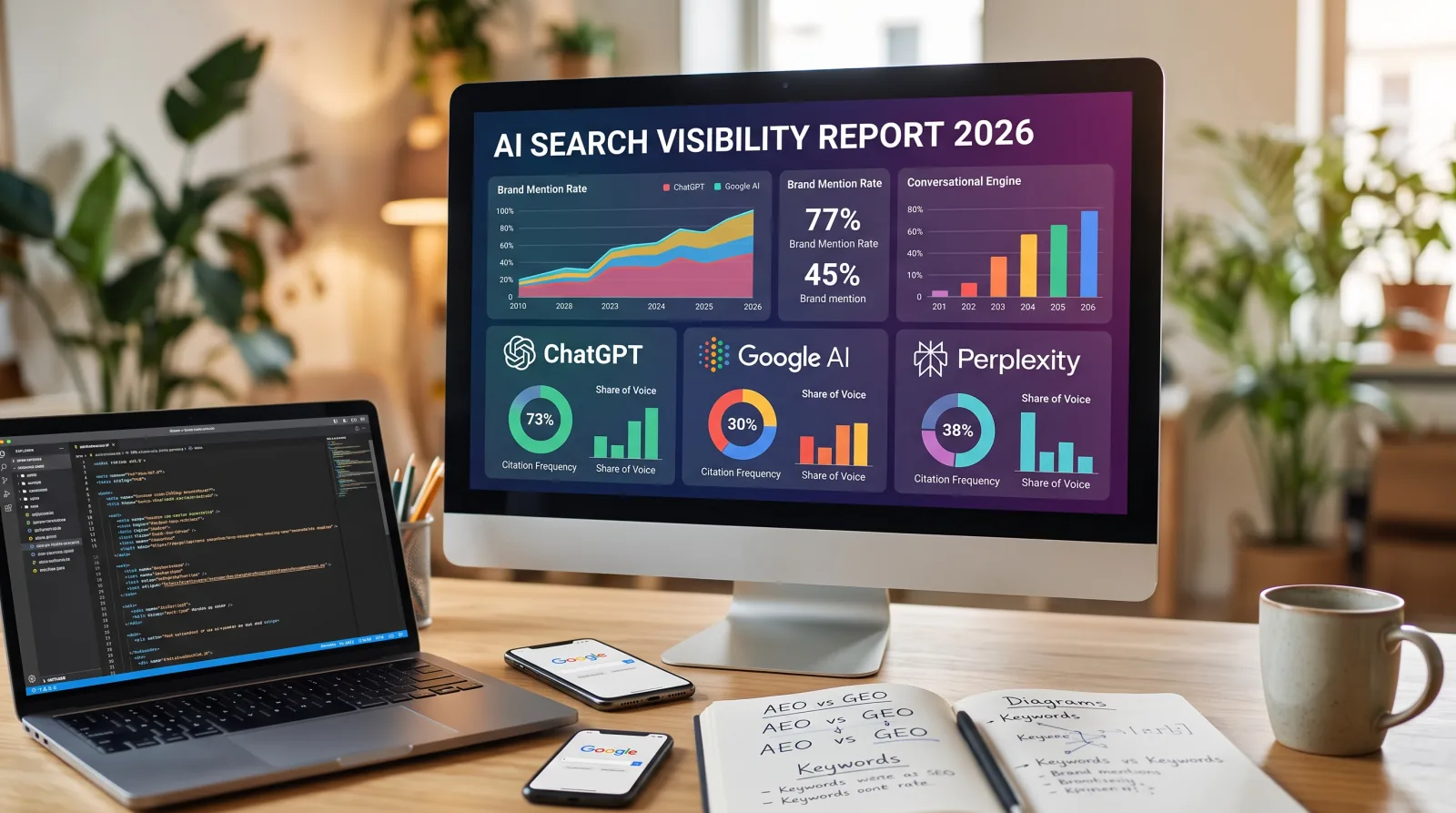
The transition of user behavior from traditional link-clicking to conversational querying is a fait accompli. Executives can no longer view answer engine optimization as an experimental subset of digital marketing. When an AI model intercepts a query, it provides a direct resolution, bypassing the traditional search engine results page entirely. If your brand visibility strategy fails to account for this shift, platforms like ChatGPT, Perplexity and Google AI will quietly steal your organic traffic. The revenue impact is immediate; as site traffic decreases from traditional search optimization efforts, businesses must capture the user within the AI overview itself. Calculating the return on investment requires measuring how often AI models cite your brand when a high-intent buyer asks a search platform for a solution.
Structured data and schema markup for AI visibility
Implementing comprehensive schema markup is now de rigueur for any answer engine optimization campaign. An AI engine does not read a webpage like a human consumer; it parses the underlying code to extract entities, relationships, and verified facts. Providing a clean structured data layer removes ambiguity, ensuring the AI system accurately interprets your business information. When an AI platform evaluates multiple sources to generate response outputs, it heavily favors domains that present data in natively machine-readable formats. Without this foundational architecture, even the most authoritative content will struggle to achieve consistent search visibility across multiple AI interfaces.
AEO vs GEO vs SEO explained
Understanding the distinction between these three disciplines is critical for an AEO agency or in-house SEO expert. Traditional SEO focuses on optimizing web pages to rank high on SERPs. AEO, or answer engine optimization, shifts the focus toward ensuring a brand is a direct mention when users ask an AI to answer question prompts. GEO, which stands for generative engine optimization, encompasses both concepts but applies them broadly to how any generative engine constructs its outputs. While traditional SEO relies heavily on site traffic signals and links, AEO/GEO frameworks rely on citation frequency and brand mention volume across authoritative third party sources. You must build a content structure that ages well across multiple AI engines, ensuring that when an AI platform evaluates sources, it finds your structured data compelling enough to cite.
What AI visibility means for business strategy
Securing a high share of voice in the AI era requires a fundamental pivot in business strategy. Every time a consumer queries an AI powered search platform, they bypass the traditional discovery funnel. A robust AI visibility strategy involves monitoring how often an AI recommendation features your product. Using a dedicated visibility tool, you can track your brand's citation frequency sentiment and conduct sentiment analysis to ensure the AI engine portrays your business accurately. A comprehensive visibility report will reveal exactly how often a platform like ChatGPT cites your brand compared to competitors.
Key Components of Visibility Score (VS)
Most AI visibility tools roll their data into a single Visibility Score (VS), usually 0 to 100. The math differs by vendor, but nearly every score is built from the same five components:
- Mention rate: the share of tracked prompts where the AI names your brand at all.
- Position or prominence: whether you appear first, in the middle, or last in the AI answer. First mention carries the most weight.
- Citation frequency: how often the AI links to your domain as a source, separate from simply naming you.
- Share of voice: your mentions as a percentage of all brand mentions for your category, compared with competitors.
- Sentiment: whether the AI describes your brand positively, neutrally, or negatively. Sentiment analysis matters because a mention that says "often criticized for slow support" is worse than no mention.
Taken together, mention frequency, sentiment, and citation frequency show how often AI names your brand and how it describes you.
Building a Pattern of Associating Your Brand With a Topic
To optimize across the entire AI ecosystem, you must establish undeniable topical authority. An AI brand recommendation does not happen by accident. You must answer the target question before anyone else and distribute that information across trusted industry nodes. This requires publishing original research, a detailed case study, and verifiable statistics that an AI system will recognize as foundational knowledge. By embedding specific structured data within your HTML, you provide the explicit context an AI model needs to understand your brand's relationship to specific concepts. When multiple third party platforms reference your research, the AI engine registers a strong pattern of associate signals, making it far more likely to recommend your business in a future AI overview.
The New Rules of AEO, GEO, and AI Search Visibility
The rules governing organic traffic have fundamentally changed. You can no longer rely solely on legacy search optimization tactics to drive search traffic. One effective strategy is to ensure your core business information remains perfectly consistent across the internet. When an AI model encounters conflicting information, it will often exclude the AI brand entirely rather than risk a hallucination. By maintaining strict control over your digital footprint and utilizing a visibility tool to monitor your brand visibility across ChatGPT and other interfaces, you safeguard your business.
You must ensure your brand maintains strong visibility across ChatGPT's interface, Perplexity's citation engine, and Google's AI Overviews long before your competitors adapt. Even if a major algorithmic shift seems like it might not happen yet, the idea is to prepare your content architecture so that your AI-transformation efforts capture maximum share of voice.
Frequently asked questions
What is the difference between AEO and GEO?
Answer engine optimization (AEO) focuses on making your brand the direct answer when someone asks a question in an AI assistant or search feature. Generative engine optimization (GEO) is broader, covering how generative engines like ChatGPT, Gemini and Perplexity understand, summarize and cite your brand in any response. In practice they overlap, which is why we deliver them together.
Does schema markup help my brand get cited by AI?
Structured data helps search engines and AI systems understand who you are and what your pages contain. It doesn't guarantee a citation, but it removes ambiguity, which makes your content easier to parse, trust and reference.
What is a Visibility Score in AI search?
A Visibility Score is a single figure, usually from 0 to 100, that AI visibility tools use to summarize how often and how prominently AI assistants mention your brand. It combines mention rate, position, citation frequency, share of voice and sentiment. Each vendor calculates it differently, so compare scores within one tool over time.
How long does it take to improve AI visibility?
It depends on your starting point and how competitive your topics are. Technical and structured data fixes can be picked up within weeks, while authority built through original content and third-party mentions grows over months.